01 / 2026
Steply
AI coach that breaks goals into manageable steps

Product
My role
About
Steply is an AI coach that helps people turn a goal into clear, manageable steps — making it easier to understand what to do, when to do it, and what to do next.
The problem
People often have personal goals, but struggle to achieve them due to the cognitive load of planning.*
Unlike structured environments (e.g., structured courses with clear roadmaps or personal trainers with defined programs), self-guided goals require people to break down steps, prioritize tasks, and manage routines on their own — often while dealing with limited time, energy, and mental focus. Many goal-tracking tools focus on organizing and monitoring predefined tasks, but leave users to figure out what those tasks should actually be.
This revealed the product opportunity Steply explores: providing structure and guidance could reduce the effort of figuring out the path alone.
The solution & hypothesis
Hypothesis: An interactive AI coach can reduce the cognitive effort of turning a goal into an actionable plan while keeping the user in control.
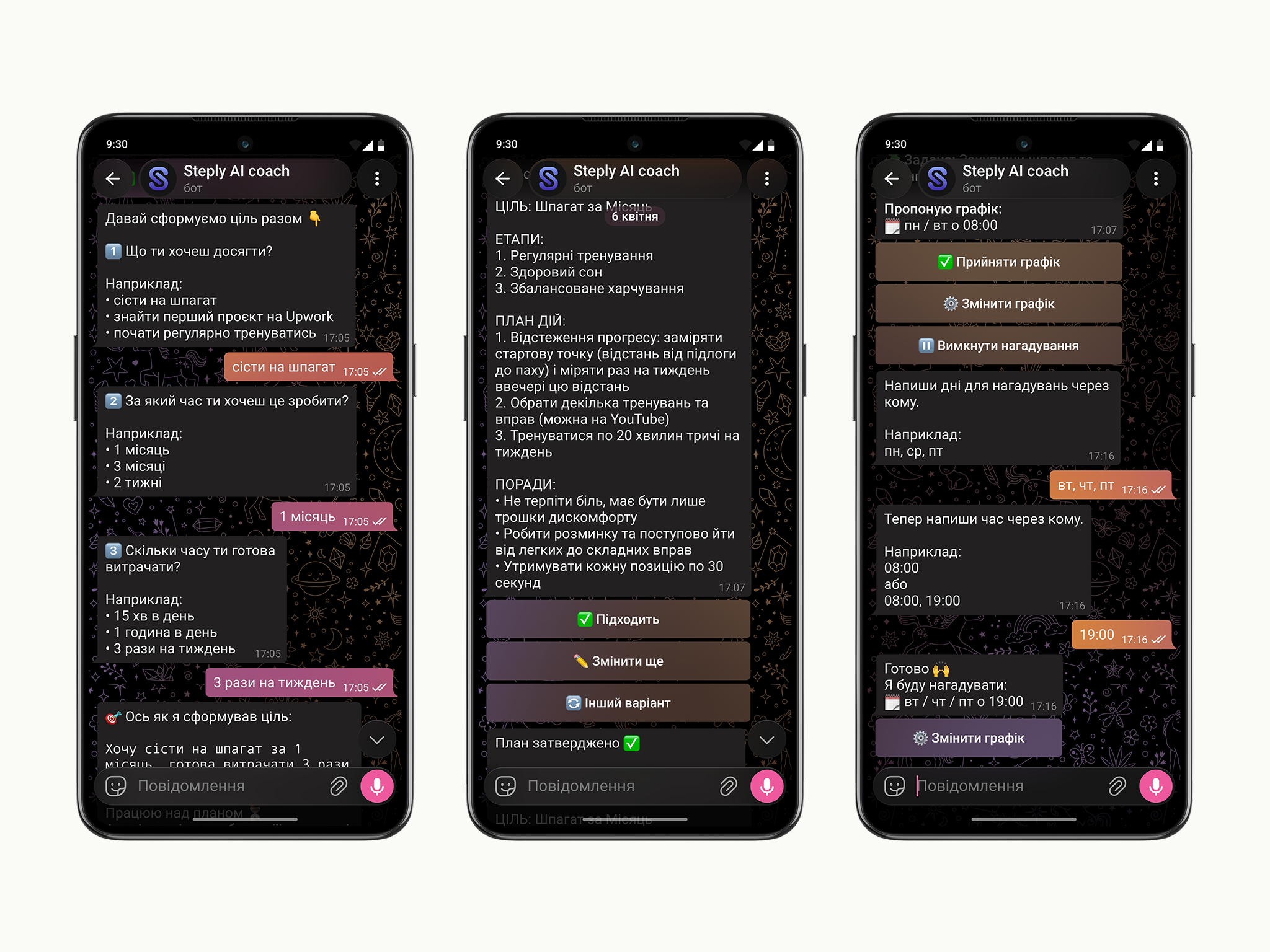
Instead of building a heavy UI with complex task-management features, Steply uses a simple conversational flow in Telegram to guide users from a vague intention to an actionable, scheduled plan.
Steply proposes the structure; the user retains full ownership of the plan.
Core user flow
PHASE 1
Onboarding & setup
Select coaching style → Set goal & timeframe
PHASE 2
Plan generation & review
AI plan generation → Interactive review & edit
PHASE 3
Output & scheduling
Approve & schedule → Timed reminders
This is an early MVP, not a finished product.
I reduced the original idea to the smallest workable version needed to explore its core value.
Scoping the MVP
I strictly prioritized interactions that prove the core loop: Goal → Actionable schedule.
Included in MVP (core loop)
- Coaching style: Select a coaching style (soft, strict, adaptive) to adjust tone.
- Goal & context definition: Input goal and timeframe for AI prompt context.
- Interactive plan approval: User-in-the-loop mechanism to edit or approve generated steps before committing.
- Basic scheduling & reminders: Convert approved steps into timed Telegram notifications.
Intentionally out of scope (saved for v2)
- Advanced progress analytics & streak tracking.
- Multi-goal simultaneous tracking.
- Evidence-backed recommendations — require dedicated R&D to ground AI-generated plans in validated, domain-specific methodologies.
Product & UX decisions
Interface choice
Telegram Bot was selected to minimize user friction and speed up testing — avoiding new app downloads while keeping MVP development fast and low-cost.
Execution
Built using AI-assisted development (VS Code, local Ollama for prompt iteration, architected to switch to production OpenAI GPT API).
AI UX consideration
Designed with a mandatory review step to avoid AI hallucination fatigue and give the user final say over their plan.
Validation strategy & next steps
Before scaling, the next step is to test the prototype with a small group of users.
Key hypotheses to test
- Value relevance: Do AI-generated steps feel realistic and actionable, or do users reject them?
- Control vs. automation: How often do users edit the generated plan before approving it?
- Follow-through: Do Telegram reminders lead to actual task completion?
Pilot success signals
- Plan approval rate: % of generated plans approved by users without dropping off.
- Task completion rate: % of scheduled tasks marked as done via reminders.
- Average edits per plan: Average number of user edits before approving the generated plan.
Research
Research informing the hypothesis: goal pursuit and implementation intentions.
- 1. Gollwitzer, P. M., & Sheeran, P. (2006). Implementation intentions and goal achievement: A meta‑analysis of effects and processes.
- 2. Koestner, R., Lekes, N., Powers, T. A., & Chicoine, E. (2002). Attaining personal goals: Self‑concordance plus implementation intentions equals success.
- 3. Sheeran, P., Listrom, C., & Gollwitzer, P. M. (2024). The when and how of planning: Meta‑analysis of the scope and components of implementation intentions in 642 tests.